
![[personal profile]](https://www.dreamwidth.org/img/silk/identity/user.png)


The economics of renewable energy
In case anyone hasn't seen it,
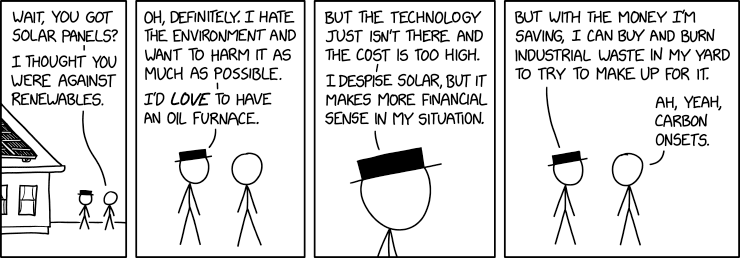
I watched a discussion last week between Paul Krugman and some energy analyst who pointed out that if wind, solar, and battery technology keep improving at the current rate for another twenty years, they'll be so cheap we'll be saying "what do we do with all this electricity?" A world in which usable energy is not scarce -- not only has that never happened in US history, not in human history, but not even in the history of life on Earth. And we could easily live to see it.
And thank you, Donald Trump, for pushing the world in that direction. Prices of gasoline, diesel, fertilizer, etc. will drop slightly when the shooting stops in Iran (whenever that is), but newly-flowing oil through the Strait of Hormuz won't reach its destinations for at least a month after that, and oil wells that were shut down due to the war won't be fully up and running for at least a month, and it'll take at least a year to rebuild the physical damage to wells and refineries done by the war. So those prices won't return to "normal" for at least a year.
This war has made clear to every nation on Earth (except the US) that depending on fossil fuels is a sucker's game, making your economy hostage to random events and unpredictable autocratic states like Russia, Iran, and the United States. The nations that have made the most progress reducing their dependence on fossil fuels (Iceland, Tajikistan, Costa Rica, Norway, Sweden, China, Paraguay, Ethiopia, Denmark, France, Switzerland, New Zealand, UK, Germany, El Salvador, Kyrgyzstan, Pakistan...) will thrive in the coming year, and those that haven't will scramble to catch up. If Donald Trump is still President, the US will be one of the last nations to acknowledge this reality; we'll be last in line to buy the technology from the Chinese (since we stopped building it ourselves) while the rest of the world enters a golden age of abundance.
I watched a discussion last week between Paul Krugman and some energy analyst who pointed out that if wind, solar, and battery technology keep improving at the current rate for another twenty years, they'll be so cheap we'll be saying "what do we do with all this electricity?" A world in which usable energy is not scarce -- not only has that never happened in US history, not in human history, but not even in the history of life on Earth. And we could easily live to see it.
And thank you, Donald Trump, for pushing the world in that direction. Prices of gasoline, diesel, fertilizer, etc. will drop slightly when the shooting stops in Iran (whenever that is), but newly-flowing oil through the Strait of Hormuz won't reach its destinations for at least a month after that, and oil wells that were shut down due to the war won't be fully up and running for at least a month, and it'll take at least a year to rebuild the physical damage to wells and refineries done by the war. So those prices won't return to "normal" for at least a year.
This war has made clear to every nation on Earth (except the US) that depending on fossil fuels is a sucker's game, making your economy hostage to random events and unpredictable autocratic states like Russia, Iran, and the United States. The nations that have made the most progress reducing their dependence on fossil fuels (Iceland, Tajikistan, Costa Rica, Norway, Sweden, China, Paraguay, Ethiopia, Denmark, France, Switzerland, New Zealand, UK, Germany, El Salvador, Kyrgyzstan, Pakistan...) will thrive in the coming year, and those that haven't will scramble to catch up. If Donald Trump is still President, the US will be one of the last nations to acknowledge this reality; we'll be last in line to buy the technology from the Chinese (since we stopped building it ourselves) while the rest of the world enters a golden age of abundance.
no subject
One more week and we'll be able to talk to our solar contractor of choice. Counting the days....
no subject
How much solar capacity you install depends on the laws of your state: in many states, if you generate less power than you use, every kWH you generate is deducted from what you buy from the grid, so you're effectively selling it at retail rates, but if you generate more power than you use, you are now a power company and can only sell it to the grid at wholesale rates. So the company that installed the panels was very careful to not go over our household usage: even on the sunniest summer days, we get a little bit of juice from the grid.
A few months ago we got an e-mail from the company offering to put us in contact with another company that installs battery backups for existing solar panels. The Biden-era IRA encouraged building battery factories in the US to support the EV industry, and when Trump pulled the rug out from under the EV industry, all those battery factories were left looking for customers, so there's something of a glut of cheap rechargeable batteries on the market right now. A battery backup enables you to avoid the "I'm generating too much so it's now at wholesale rates" problem by time-shifting your contribution to the grid. So I called the company and we concluded that the battery backup would make financial sense if we were sometimes generating more than our daily consumption, but we're not so it doesn't.
This winter I learned that if you don't have a battery backup and the grid power goes out completely, your solar converter automatically turns off for safety reasons: when the workers come around to fix the lines, they assume the line to your house is dead, and this ensures that it is (and they're not). A battery backup means your converter doesn't need to automatically shut off when the grid dies; the power can go into the battery rather than the grid. So that's another advantage of a battery backup. But they cost a bunch more money.
As XKCD and Paul Krugman will point out, the technology (both solar and battery) has gotten much more efficient since 2013, so the numbers will work out completely differently for you.
I'm not sure what happens in 2033 when our twenty-year lease is up. Legally, the solar panels revert to the company that bought the company that bought the company that installed them, and they would be within their rights to de-install them, but I don't think anybody wants twenty-year-old solar panels so de-installing them would be more trouble than it's worth. Whether we (or the next owner of the house) want to replace them with up-to-date panels is another question.